Nplate® is a thrombopoietin receptor agonist indicated for the treatment of thrombocytopenia in adult patients with immune
... Read More
Once-weekly Nplate® can provide ITP control—have confidence in your choice1
Reduce complexity for your patients
 ONCE-WEEKLY administration1
 NO known drug interactions*
 NO calcium or other dietary restrictions1
*No formal drug interaction studies of Nplate® have been performed.2
Save this
page
Nplate® dosing calculator
4 easy steps to calculate your patient's total Nplate® injection volume1
This tool provides calculation assistance only. It is not designed or intended to replace the physician’s clinical judgment in determining the appropriate dose for his or her patient.
- Adult patients: Actual body weight at initiation of therapy should always be used when calculating the dose.
- Pediatric patients: Base future dose adjustments on changes in platelet counts and body weight (reassessment of body weight every 12 weeks is recommended).1
STEP 3: Note total dose (mcg) and injection volume
(mL)
Patient's Total Dose--
Patient's Total Dose (mcg) =
patient's weight (kg) x dose (mcg/kg)
patient's weight (kg) x dose (mcg/kg)
Injection Volume--
Injection Volume (mL) =
patient's total dose
500 mcg/mL
patient's total dose
500 mcg/mL
STEP 4: Determine Nplate® vial(s) required for
single use
Using your patient's total dose and/or injection volume calculated in STEP 3, refer to the full Prescribing Information to determine the appropriate vial required for single-use dose
Using your patient's total dose and/or injection volume calculated in STEP 3, refer to the full Prescribing Information to determine the appropriate vial required for single-use dose
Watch the directions for Nplate® reconstitution and administration
†The recommended starting dose for Nplate® is 1 mcg/kg.1
Individualize ITP treatment with Nplate®
Tips for dosing success
- The initial dose for Nplate® is 1 mcg/kg based on actual body weight1
- Administer Nplate® as a once-weekly subcutaneous injection with dose adjustments based upon the platelet count response1
- See the Nplate® titration guide to Start, Adjust, Maintain, and Monitor
- Use the lowest dose of Nplate® to achieve and maintain a platelet count ≥ 50 x 109/L as necessary to reduce the risk for bleeding1
- As the injection volume may be very small, use a syringe that contains 0.01 mL graduations1
Watch the directions for Nplate® reconstitution and administration
†The recommended starting dose for Nplate® is 1 mcg/kg.1
Dose for ITP control
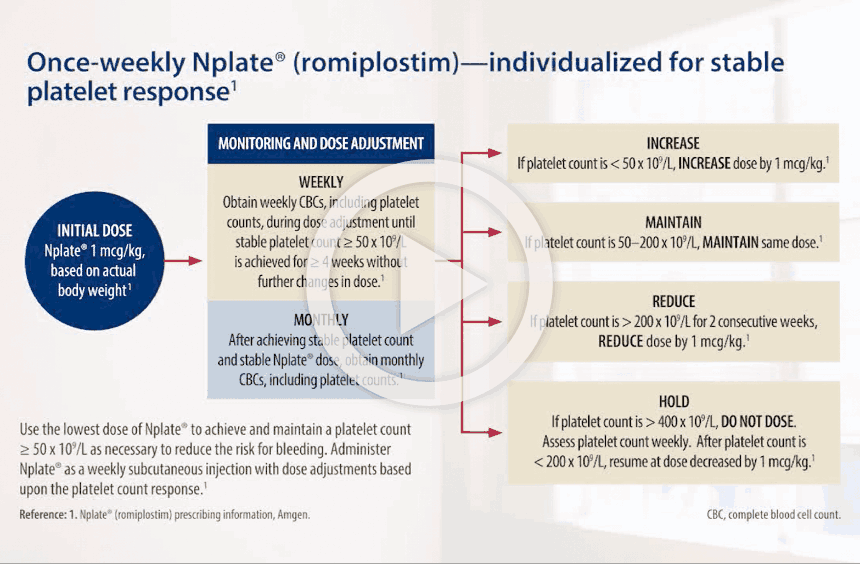
Use the lowest dose of Nplate® to achieve and maintain a platelet count ≥ 50 x 109/L as necessary to reduce the risk for bleeding. Administer Nplate® as a once-weekly subcutaneous injection with dose adjustments based upon the platelet count response. Do not exceed maximum weekly dose of 10 mcg/kg.1
- Adult patients: Actual body weight at initiation of therapy should always be used when calculating the dose.
- Pediatric patients: Base future dose adjustments on changes in platelet counts and body weight (reassessment of body weight every 12 weeks is recommended).1
Start
Start
Initial dose: 1 mcg/kg
based on actual
body weight.1 If calculated dose is less than 23 mcg, additional dilution with 0.9% Sodium Chloride is required.
Please refer to Table 1 in the Prescribing Information for instructions on dilution.
based on actual
body weight.1 If calculated dose is less than 23 mcg, additional dilution with 0.9% Sodium Chloride is required.
Please refer to Table 1 in the Prescribing Information for instructions on dilution.
Adjust
Adjust
Obtain weekly complete blood counts (CBCs), including platelet counts, during dose adjustment
until stable platelet count ≥ 50 × 109/L is achieved for ≥ 4 weeks
without further changes in dose.1
- If platelet count is < 50 × 109/L, increase by 1 mcg/kg.1

- If platelet count is > 200 × 109/L for 2 consecutive weeks, reduce by 1 mcg/kg.1

- If platelet count is > 400 × 109/L, DO NOT DOSE. Assess platelet count weekly. After platelet count is < 200 × 109/L, resume at dose decreased by 1 mcg/kg.1

Maintain
Maintain
If platelet count is 50–200 × 109/L, maintain dose and assess CBCs weekly until
stable platelet count ≥ 50 ×
109/L is achieved for ≥ 4 weeks without further changes in dose.1
MONITOR
MONITOR
Obtain CBCs, including platelet counts, weekly during the dose adjustment phase of
Nplate® therapy and then monthly following establishment of a stable Nplate® dose. Obtain CBCs, including platelet counts, weekly for at least 2 weeks following discontinuation
of Nplate®.1
Titrate Nplate® according to individual patient response; adjust the weekly dose of
Nplate® by increments of 1 mcg/kg until the patient achieves a platelet count of
≥ 50 x 109/L, as necessary, to reduce the risk of bleeding.1
Do not exceed maximum weekly dose of 10 mcg/kg.1
To mitigate against medication errors (both overdose and underdose), ensure that the preparation and administration instructions in the full Prescribing Information are followed.
Discontinuation
Discontinue Nplate® if the platelet count does not increase to a level sufficient to avoid
clinically important bleeding after 4 weeks of Nplate® therapy
at the maximum weekly dose of 10 mcg/kg. Obtain CBCs, including platelet counts, weekly for at least 2
weeks following discontinuation of Nplate®.1
Dose for confidence
See what Nplate® dosing‡ and administration might look like for you and your practice
Always reference the complete dosing and administration information in the full prescribing information for Nplate®. Download now
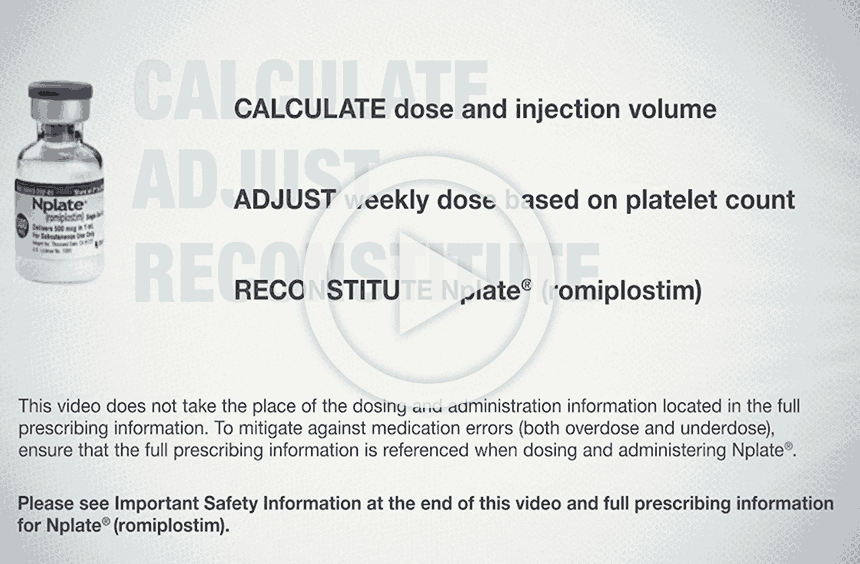
Nplate® Adult Dosing and Reconstitution
Nplate® Adult Dosing Perspectives
Dosing and Reconstituting Nplate® (video at left)(video at top) provides an overview of the preparation and administration process.
Nplate® Dosing Perspectives (video at right)(video at bottom) follows two leading hematologists, Dr. Michael Tarantino from the Bleeding and Clotting Disorders Institute, IL, and Dr. Terry Gernsheimer from the Seattle Cancer Care Alliance, WA, as they discuss Nplate® dosing and titration to address their patients' needs.
‡The recommended starting dose for Nplate® is 1 mcg/kg.1 Please see the Nplate® full Prescribing Information for complete dosing instructions, including guidelines for dose adjustments.